May 29 2026 & June 1 2026 - Video Support & Review Answer Key - The 1930’s – Depression Era , Hitler's Rise To Power Birth to 1939 - Timeline Review - Read Pages 245-247 & 250-258 Creating Canada Text
The 1930’s – Depression Era
Reviewed on Friday May 29th - and to re-review - Monday June 1 -
Hitler's Rise To Power - overview. - we reviewed up to and including 1938
Key points:
20 April 1889 Born - Austria-Hungary - to civil service worker (father - customs) - poor peasant background
Age of 6 - does not make it very far in elementary school - high intelligence - cannot function within formal environment.
1907 - Age 18
Hitler moves to Vienna - capital of Austria - with the aim of attending the Vienna Academy of Art, but his application is rejected. His disappointment is compounded by his failure to also get into the Vienna School of Architecture due to his inability to provide a school leaving certificate.
1909-1913 - lives as a street artist - postcards - Vienna - poor - also - Hitler engages in much political activity, attending meetings, absorbing political newspapers and literature.
1913- Faced with military service for the Austrian Hitler takes action to evade this by moving to Munich in Southern Germany. This move is possible in part due to his inheritance of a small legacy from his father’s estate.
1914 - WW1 Starts - Hitler volunteers for service in the German army and joined the 16th Barvarian Reserve Infantry Regiment. He distinguishes himself in service, being promoted to corporal and decorated with the Iron Cross for services as a runner on the western front.
1919 -Hitler is appointed to the Intelligence/Propaganda section where he undertakes political training. His activities involve making speeches to the troops advocating German nationalism and anti-Socialism, where he developed further his oratory (speaking) skills.
He also acts as an army informer, spying on small political parties. He joins the German Workers’ Party, an extreme anti-communist, anti-Semitic right wing organization.
NOTE:
1920 - Hitler is discharged from the army. In the German Worker’s Party he undertakes responsibility for publicity and propaganda. He changes the party’s name to the National Socialist German Workers Party, (or Nazi for short)
1921
Hitler challenges Anton Drexler to become leader of the Nazi party. After initial resistance, Drexler agrees and Hitler becomes the new leader of the party.
1923
Along with other right wing factions and General Ludendorff he attempts to overthrow the Bavarian government with an armed uprising. The event became known as The Beer Hall Putsch. Hitler and 2000 Nazi’s march through Munich to the Beer Hall, to take over a meeting chaired by three of the most important individuals in Bavarian politics. Captured - spends 9 months in jail - writes - Mein Kampf (my struggle). It is a mixture of autobiography, political ideology and an examination of the techniques of propaganda.
1925 Hitler re-founds the Nazi party.
September 1930
In the General Election, the Nazi Party increases its representatives in parliament from 14 to 107. Hitler is now the leader of the second largest party in Germany.
1931 Hitler challenges Paul von Hindenburg for the presidency, but fails to win.
1932
Hitler becomes a German citizen—enabling him to stand in the Presidential election against Hindenburg.
Became the first person to electioneer by aircraft, the campaign (masterminded by Josef Goebbels) was entitled 'Hitler over Germany'.
January 1933
Hitler becomes chancellor of a coalition government, where the Nazis have a third of the seats in the Reichstag.
The German Reichstag is destroyed by fire. The plot and execution is almost certainly due to the Nazis but they point the finger at the communists and trigger a General Election.
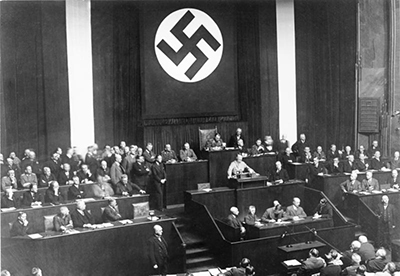 Adolf Hitler addressing the Reichstag on 23 March 1933, seeking assent to the Enabling Act.The Enabling Act passed—powers of legislation pass to Hitler’s cabinet for four years, making him virtual dictator.
He proclaims the Nazi Party is the only political party permitted in Germany. All other parties and trade unions are disbanded. Individual German states lose any autonomous powers, while Nazi officials become state governors.
Communist party banned.
Socialists, Trade Unions and strikes banned.
Hitler withdraws from the League of Nations. In the following months, he trebles the size of the German Army and ignores the arms restrictions imposed by the Treaty of Versailles.
Night of the Long Knives. Hitler crushes all opposition within his own party—thus eliminating any of his rivals.
After the death of President Hindenburg, Hitler becomes “Fuehrer and Reich Chancellor” and abolishes the title of President.
Hitler re-arms Germany with the aim of undoing the Treaty of Versailles and uniting all the German peoples. Military conscription is introduced.
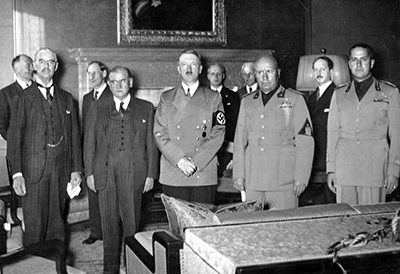 Chamberlain, Daladier, Hitler, Mussolini, and Ciano before signing the Munich AgreementThe Austrian Chancellor, leader of the Austrian Nazi Party, invites the German army to occupy Austria and proclaim a union with Germany.
British Prime Minister, Neville Chamberlain meets Hitler in Germany. Britain, France and Italy sign the Munich Agreement which gives the Sudetenland (the German populated borderlands of Czechoslavakia), to Germany.
German army occupies the Sudetenland.
In what is historically referred to as Crystal Night, 7,500 Jewish shops are destroyed and 400 synagogues are burnt. The attack is portrayed as a spontaneous reaction to the death of a German diplomat by a Jewish refugee in Paris. It is actually orchestrated by the Nazi party who also kill many Jews and send 20,000 to concentration camps.
Crystal Night is considered to be the beginning of the Final Solution and the Holocaust, which you can study in more depth. The mass killing represented by the Holocaust raises many questions concerning the development of European civilisation during the twentieth century.
Review - Pages 245-247 & 250-258 Creating Canada Text - Videos on each segment covered below.
Stock Market Crash of 1929 - Decades TV Network 3 min
Viewed - May 29 2026
To View - June 1 2026
Antisemitism in Germany After World War I
Introducing The Dust Bowl PBS 2 min
Comments
Post a Comment